
A quality audit can expose problems that are much larger than a single out-of-tolerance dimension.
The issue may involve incomplete inspection records, an incorrect datum strategy, inconsistent measurement methods, a manufacturing change that was never verified, or a component that does not match the engineering definition as expected.
Dimensional inspectioncannot guarantee that a company will pass a quality audit. What it can provide is objective measurement information that helps engineering, manufacturing and quality teams understand the actual condition of parts, tooling and assemblies.
When the measurement strategy is tied directly to the drawing, CAD model, GD&T requirements and intended engineering decision, the resulting inspection record can become an important part of a defensible quality process.
Why Dimensional Problems Can Surface During Quality Reviews
Incomplete Measurement Information
An inspection record is only useful when it clearly identifies what was measured, how the part was established, which engineering requirements controlled the evaluation and what the measured results actually showed.
When required characteristics are missing, measurement methods are inconsistent or reporting does not clearly relate the results to the engineering definition, additional questions may arise during customer or quality review.
Datum and Alignment Problems
Measurement results depend heavily on how the component is established in the coordinate system.
A part evaluated using the wrong datum structure or an inappropriate best-fit alignment may produce results that do not represent the engineering requirement.
IMS selects the alignment strategy according to the controlling drawing, CAD model, datum reference frame or customer-defined coordinate system.
GD&T Requirements
Geometric Dimensioning and Tolerancing defines more than simple linear dimensions.
Depending on the drawing, inspection may require evaluation of characteristics such as position, profile, flatness, straightness, perpendicularity, parallelism, angularity, runout, feature size and datum relationships.
The inspection method must reflect the actual engineering requirement rather than applying the same measurement process to every part.
Problems Found Too Late
Waiting until manufacturing is complete to discover a dimensional issue can make correction more difficult.
In-process inspection allows dimensional conditions to be evaluated during fabrication, machining, assembly or installation while corrective action may still be practical.
This can give engineering and manufacturing teams useful information before subsequent operations make a condition harder to correct.
How Dimensional Inspection Supports Quality Documentation
Dimensional inspection provides measured evidence of how a component, tool or assembly compares with its defined engineering requirements.
Depending on the project, IMS can perform:
- CAD to part inspection
- Drawing based inspection
- GD&T inspection
- First article inspection
- In-process inspection
- Final acceptance inspection
- Tooling and fixture inspection
- Assembly inspection
- As-built inspection
- Surface and profile inspection
- Feature location
- Deformation and distortion analysis
The appropriate approach depends on the component size, tolerance, geometry, surface condition, environment, available engineering information and required deliverable.
CAD to Part Comparison
When nominal CAD is available, measured geometry can be compared directly with the engineering model.
This can identify dimensional variation between the manufactured component and its nominal definition.
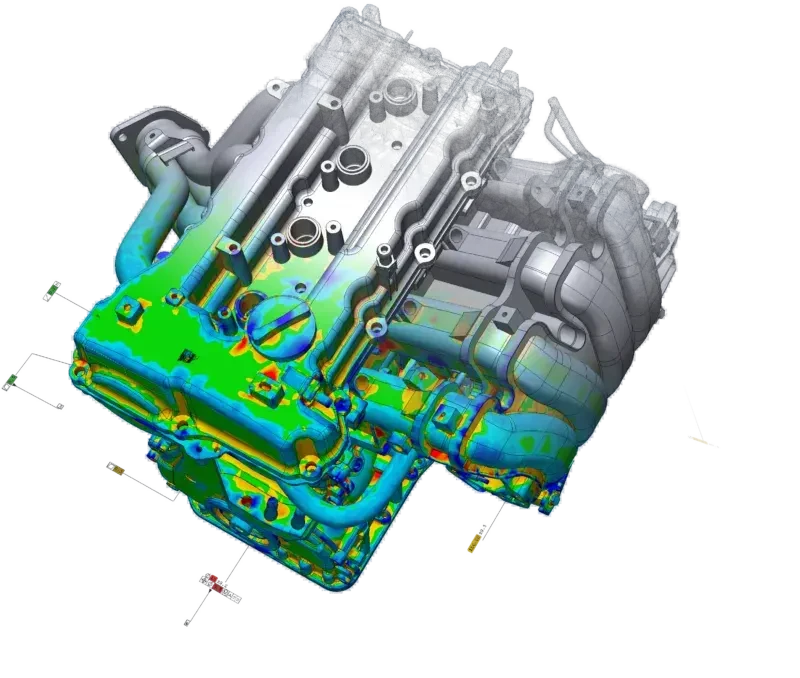
Results may include individual dimensional characteristics or full-surface deviation maps.
For complex geometry, a deviation map can help engineers see patterns that may be difficult to recognize from isolated measurement points alone.
These patterns may include:
- Localized high or low conditions
- Surface variation
- Profile deviation
- Bow
- Twist
- Distortion
- Interface mismatch
- Assembly variation
Inspection Directly From Engineering Drawings
A complete 3D CAD model is not required for every inspection.
IMS can perform dimensional inspection from customer-provided 2D engineering drawings when the drawing is the controlling engineering document.
Inspection results can also be communicated in familiar engineering formats.
When appropriate, deviation information can be overlaid onto a drawing so engineers, technicians and quality personnel can view measured variation in the same orientation they use for the engineering definition.
Beyond a Simple Pass or Fail
A pass/fail result answers whether a measured characteristic meets the specified requirement.
When something does not meet the requirement, the next question is often more important:
What is the actual geometric condition?
Dimensional data can help characterize where the deviation is located, how large it is, whether the condition is localized or distributed and how it relates to surrounding features or interfaces.
Measurement alone does not always establish the root cause of a manufacturing problem.
It can, however, provide objective information that helps engineering and manufacturing teams investigate the condition and determine the appropriate corrective action.
Consistent Measurement Strategy Matters
Different measurement technologies have different strengths.
IMS does not assume that one instrument is appropriate for every inspection.
Depending on the requirement, measurement may involve:
- 3D laser scanning
- Laser tracker measurement
- Photogrammetry
- Total station measurement
- Controlled hybrid measurement networks
Equipment selection should follow the required tolerance, measurement volume, geometry, accessibility, environment, point density and final engineering deliverable.
For large or accuracy-sensitive inspections, a controlled reference network may also be used to maintain a common coordinate framework across multiple instrument positions or technologies.
Environmental and Measurement Control
Parts and measurement systems do not exist independently of their environment.
Temperature, material expansion, instrument drift and movement within the measurement environment can affect dimensional results.
For appropriate projects, IMS may incorporate:
- Environmental temperature monitoring
- Part temperature monitoring
- Humidity monitoring
- Drift monitoring
- Reference or control measurements
- Material coefficient of thermal expansion
- Network stability checks
There is no responsible universal accuracy value that applies to every dimensional inspection.
Measurement uncertainty depends on the equipment, geometry, measurement volume, environment, reference strategy and inspection method.
Critical tolerance requirements should be evaluated against the capability of the proposed measurement system before the inspection begins.
Inspection Reporting
The report should match the purpose of the measurement.
Depending on customer requirements, deliverables may include:
- Dimensional inspection reports
- GD&T results
- Ballooned drawing results
- Pass/fail results when acceptance criteria are defined
- CAD to part comparison
- Surface deviation maps
- Drawing overlays
- Deviation callouts
- XYZ coordinate data
- Feature measurements
- Screenshots and visual results
- Alignment results
- Statistical summaries when applicable
- Raw measurement data when appropriate
- Customer-specific reporting formats
Defining reporting requirements before measurement begins helps ensure the inspection is performed with the final engineering decision in mind.
Quality Audits and Dimensional Evidence
Dimensional inspection should not be presented as a guarantee of regulatory or quality-system compliance.
Quality audits can evaluate many areas outside metrology, including procedures, documentation systems, process controls, training, traceability and organization-specific requirements.
Dimensional inspection addresses one important part of that larger system: objective evidence about the physical geometry of the product, tooling or assembly.
When properly planned and documented, that evidence can help a quality or engineering team demonstrate how the component was evaluated against its defined dimensional requirements.
Mobile Dimensional Inspection
Many components, tooling systems and assemblies cannot practically be transported to a conventional inspection laboratory.
IMS provides portable dimensional inspectionat customer facilities and project locations.
Based on Florida's Space Coast, IMS supports projects throughout Florida and travels nationwide and internationally when project requirements justify mobilization.
A Better Question Than "Will We Pass the Audit?"
The stronger question is:
Can we clearly demonstrate what was required, what was measured, how it was evaluated and what the result showed?
That is where a disciplined dimensional inspection process becomes valuable.
The goal is not to create paperwork simply for the sake of an audit. The goal is to produce measurement information that engineering, manufacturing and quality teams can understand, evaluate and act on.
Discuss Your Inspection Project
If you need dimensional verification for a component, tool, assembly or manufacturing process, send IMS the available CAD or drawings, required tolerances, datum requirements, project location and desired inspection deliverable.
IMS can evaluate the engineering requirement and determine an appropriate measurement strategy.
Discuss Your Project