
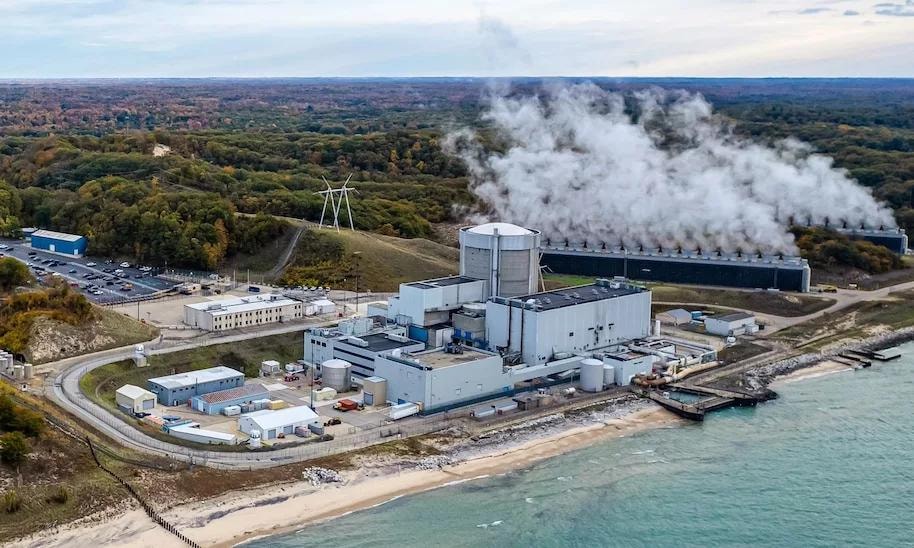
Three closed nuclear power plants in the United States are being prepared for a possible return to service. The projects could restore approximately 2.25 gigawatts of electricity generation, enough to serve roughly 2 million homes and businesses.
The U.S. Department of Energy is supporting the projects with loans totaling up to $4.4 billion.
Growing electricity demand, including demand from artificial intelligence data centers, is helping drive renewed interest in nuclear power.
Bringing these facilities back online involves more than restarting equipment. Engineers must inspect aging infrastructure, verify mechanical systems and confirm that critical components meet operational requirements.
Precision measurement has an important role in that process.
Three Nuclear Facilities Preparing for Restart
The projects involve three previously closed facilities.
Palisades Nuclear Power Plant, Michigan
Palisades operated from 1971 until 2022. Holtec International is working toward restarting the facility, with a target of March 2027.
The project has received federal and state support. Before operations resume, the facility must satisfy applicable regulatory requirements and complete necessary equipment evaluations.
Crane Clean Energy Center, Pennsylvania
The Crane Clean Energy Center is located at the Three Mile Island site.
Constellation Energy plans to restart the site's undamaged Unit 1 reactor, which shut down in 2019. This is separate from Unit 2, which was damaged in the 1979 accident.
Microsoft has entered a long-term agreement to purchase electricity from the restarted facility. The planned return to service is targeted for 2027.
Duane Arnold Energy Center, Iowa
Duane Arnold closed in August 2020 following storm damage.
NextEra Energy is working with Google on a restart targeted for early 2029.
In September 2026, the Department of Energy announced a loan of up to $1.9 billion to support the project. The facility is expected to provide approximately 615 megawatts of generating capacity if the restart receives the necessary approvals.
Why Restarting a Nuclear Plant Requires Extensive Inspection
A nuclear facility that has been offline for several years requires a detailed assessment before returning to operation.
Equipment condition, maintenance records, regulatory compliance and the integrity of critical systems all require attention.
Mechanical components can experience dimensional changes from thermal cycling, vibration, wear and long-term operating conditions.
Engineers must determine whether equipment still meets applicable design and operational requirements.
For some inspection and modernization tasks, precision measurement technologies provide the dimensional information needed to make those decisions.
How 3D Laser Scanning Supports Nuclear Facility Modernization
Nuclear power plants contain extensive piping networks, structural supports, mechanical equipment and confined work areas.
Original engineering drawings may not reflect every modification made during decades of operation.
3D laser scanning captures detailed measurements of existing structures and equipment. The resulting point clouds can support accurate as-built models.
Engineers use this information to:
- Document existing equipment and piping geometry.
- Plan equipment replacement and installation.
- Identify potential spatial conflicts.
- Compare existing conditions with proposed modifications.
- Reduce uncertainty during retrofit planning.
Accurate as-built information helps engineering teams plan modifications before equipment arrives on site.
Laser Trackers and Dimensional Inspection
Laser trackers measure precise three-dimensional coordinates across large work areas. They are useful when engineers need to verify equipment alignment, component locations or assembly geometry.
During nuclear facility maintenance and modernization, applicable dimensional measurement work may include:
- Checking equipment positioning and alignment.
- Verifying mounting surfaces and structural interfaces.
- Measuring replacement components.
- Comparing manufactured parts against engineering models.
- Supporting installation and assembly verification.
Measurement methods must be selected according to the required tolerances, access conditions and applicable quality procedures.
For safety-related nuclear applications, qualified personnel, documented procedures and regulatory requirements remain essential.
Precision Alignment During Equipment Installation
Large industrial equipment depends on correct alignment. Improper alignment can contribute to vibration, mechanical wear and premature component failure.
Precision alignment methods help technicians evaluate the position and orientation of equipment during installation or maintenance.
The appropriate measurement approach depends on the equipment, its operating requirements and the manufacturer's specifications.
Laser trackers, optical measurement systems and other precision instruments can provide the data required for these evaluations.
What This Means for the Metrology Industry
The proposed nuclear restarts create renewed attention around the condition of existing industrial infrastructure.
Modernization projects require accurate information about structures and equipment that may have been installed decades earlier.
That creates applications for dimensional inspection, reverse engineering, 3D laser scanning and precision alignment across a range of industrial sectors.
IMS provides precision measurement services for industrial and manufacturing applications, including work in the nuclear power generation sector. Our capabilities include 3D laser scanning, laser tracker measurement, dimensional inspection and precision alignment.
IMS is not contracted to work on the Palisades, Crane Clean Energy Center or Duane Arnold restart projects.