
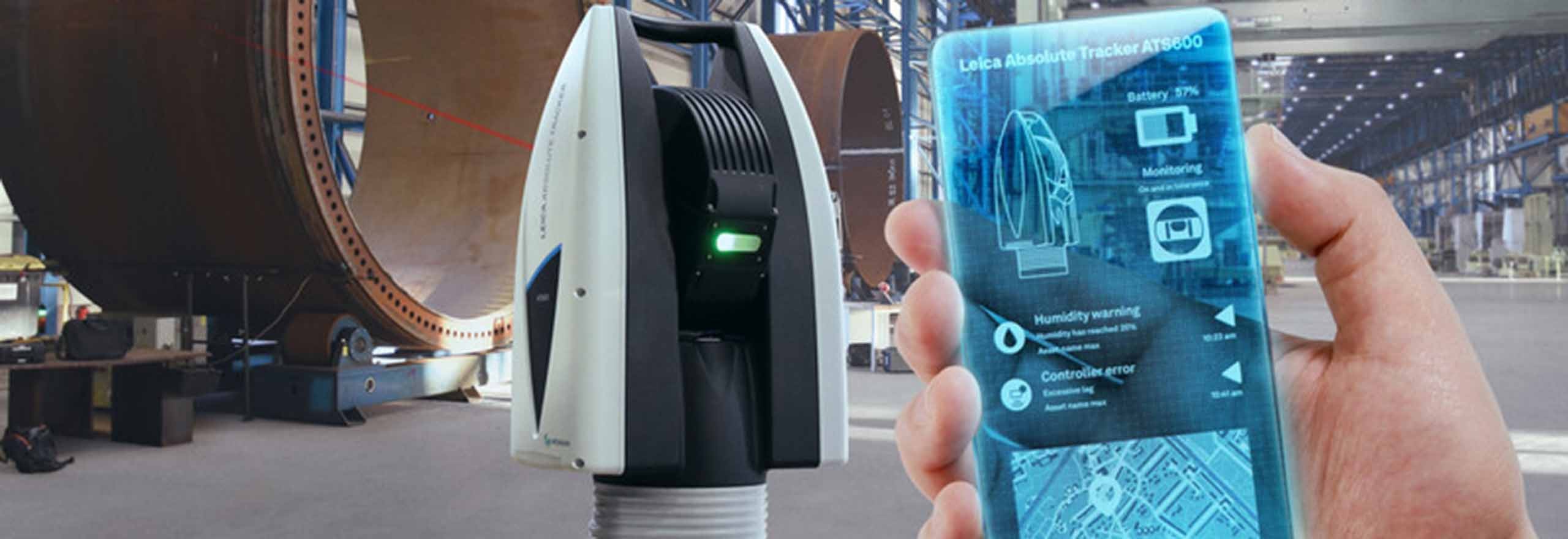
Laser trackers have become an important measurement tool for large components, tooling, machinery and assemblies that can be difficult or impractical to measure with conventional stationary inspection equipment.
The technology is capable, but selecting a laser tracker measurement provider should involve more than asking what brand of tracker the company owns.
A successful measurement project depends on the complete measurement process. The provider must understand what needs to be measured, why it is being measured, the required tolerance, the working environment, the coordinate system and how the resulting data will be used.
For companies evaluating a laser tracker measurement service, the following questions can help determine whether a provider is prepared to deliver useful, defensible measurement results.
1. Does the Provider Start With the Engineering Requirement?
The first conversation should not simply be about equipment.
A qualified metrology provider needs to understand the engineering objective behind the measurement.
Are you inspecting a manufactured component against CAD? Aligning machinery? Verifying tooling? Checking an assembly before installation? Establishing dimensional control across a large structure?
Those applications can require very different measurement strategies.
At Innovative Measurement Solutions, the engineering requirement determines the measurement approach. The component, tolerance, measurement volume, accessibility, environment and required deliverable are considered before selecting the final measurement strategy.
This distinction matters because the most sophisticated measurement instrument available is not automatically the correct tool for every project.
2. Does the Provider Understand Measurement Uncertainty?
Laser tracker accuracy should never be reduced to a single number without context.
Measurement results can be influenced by distance, geometry, environmental conditions, instrument setup, target selection, reference network design and other aspects of the measurement process.
NIST research on large-scale dimensional metrology has examined laser tracker error modeling, performance evaluation, standardization and measurement uncertainty. NIST also notes that environmental conditions, vibration, installation and transportation can affect tracker performance.
A provider should therefore be willing to discuss whether the proposed measurement approach is appropriate for your tolerance instead of simply quoting the best accuracy number from an equipment specification sheet.
3. How Will the Coordinate System Be Established?
Accurate individual points are not enough if the measurement is established in the wrong reference system.
Before work begins, the provider should understand how the physical component will relate to the engineering coordinate system.
Depending on the project, that could involve datum features, tooling points, monuments, established control points, CAD geometry or another defined reference.
This becomes particularly important when measurements must be repeated, compared with CAD, transferred between tracker positions or integrated with information collected by another measurement technology.
The coordinate system is part of the measurement strategy, not an administrative step performed after the data is collected.
4. Can the Provider Measure the Component Where It Actually Exists?
One of the major advantages of laser tracker metrology is portability.
Large components, machinery, tooling and installed assemblies often cannot be transported to a conventional inspection laboratory. Laser tracker measurement allows the measurement system to be brought to the component.
IMS provides mobile laser tracker measurement at customer facilities and project sites throughout Florida and also supports projects nationwide and internationally.
When evaluating a provider, discuss site conditions before scheduling the project. Access restrictions, vibration, temperature changes, line of sight and equipment movement can all influence how the work should be planned.
5. Does the Provider Have Experience With Large Measurement Volumes?
Measuring a small component near the tracker and controlling a large assembly across an extensive work area are different metrology problems.
NIST describes laser trackers as widely used in large-scale manufacturing and assembly because of their accuracy, portability and large working volume. NIST research has also examined network measurement methods involving fixed targets measured from multiple tracker positions.
For large-volume work, ask the provider how tracker relocation, reference points and network geometry will be handled.
The objective is to maintain a controlled reference as the measurement expands beyond a single convenient instrument position.
6. Does the Provider Evaluate Environmental Conditions?
Portable metrology frequently operates on manufacturing floors, inside facilities, around large machinery and at active project sites.
These environments are not controlled metrology laboratories.
Temperature variation, vibration, air movement, equipment operation and the thermal condition of the component can influence the measurement process.
A competent provider should evaluate these conditions rather than treating every project as though it were being performed under identical laboratory conditions.
For demanding measurements, environmental stability may influence when measurements are collected, where equipment is positioned and how the measurement sequence is structured.
7. Is the Laser Tracker Actually the Right Technology?
A good laser tracker provider should be willing to tell you when a laser tracker is not the best solution.
Some applications require dense surface information rather than individual coordinate measurements. Others may involve geometry, scale or accessibility that makes another technology more appropriate.
IMS works with multiple portable metrology technologies, including laser trackers, 3D scanning and industrial photogrammetry. These technologies can be used independently or combined when the application requires different types of measurement information.
The measurement requirement should determine the technology, not the equipment a provider happens to have available.
8. What Deliverables Will You Receive?
Collecting measurement data is only part of the project.
Before hiring a provider, determine exactly what information will be delivered when the measurement is complete.
Depending on the application, deliverables may include dimensional inspection results, CAD comparison, alignment information, measured coordinates, deviation analysis, reports or engineering data for subsequent manufacturing and assembly decisions.
The appropriate deliverable should be established before data collection begins.
This helps ensure that the measurement strategy captures the information necessary to answer the engineering question that initiated the project.
9. How Does the Provider Verify Equipment Performance?
Laser tracker performance evaluation is a mature area of dimensional metrology.
ASME B89.4.19 establishes performance evaluation methods for laser tracker systems. NIST has conducted extensive research into these methods and the geometric errors they are designed to detect. More recent work addresses interim testing under ASME B89.4.19-2021 and ISO 10360-10:2021, including field tests intended to help identify systematic errors.
For critical work, it is reasonable to ask a provider how equipment performance, calibration status and appropriate field checks are managed.
This is more meaningful than simply asking how new the tracker is.
10. Does the Provider Understand What Happens After the Measurement?
Metrology should produce information that supports an engineering or manufacturing decision.
The measurement may determine whether a component conforms to requirements, where machinery needs adjustment, whether tooling needs correction, whether components will fit during assembly or where actual geometry differs from the engineering model.
That requires more than operating a tracker.
The provider should understand how measurement information fits into inspection, alignment, manufacturing, assembly, tooling verification, reverse engineering or other downstream engineering processes.
What Should You Send a Laser Tracker Provider Before Requesting a Quote?
Providing useful project information early can make it easier to determine the appropriate measurement approach.
When available, send:
- A description of what needs to be measured
- Photographs of the component or work area
- Drawings or CAD data
- Approximate component dimensions
- Required tolerances or measurement objectives
- Project location
- Accessibility or line-of-sight limitations
- Required deliverables
- Scheduling or production constraints
You do not need to determine the measurement technology yourself.
If you can clearly explain the engineering problem, an experienced metrology provider should be able to help determine an appropriate measurement approach.
Choosing a Laser Tracker Measurement Provider
The best laser tracker measurement service is not necessarily the company with the newest instrument or the longest equipment list.
What matters is whether the provider can develop a measurement strategy appropriate for the engineering requirement.
That means considering tolerance, geometry, scale, coordinate systems, environment, accessibility, uncertainty and the information your team needs from the final measurement.
Innovative Measurement Solutions provides portable laser tracker measurement for dimensional inspection, alignment, tooling, machinery, aerospace structures and large-scale assemblies. IMS is based in Rockledge on Florida's Space Coast and supports projects throughout Florida, nationwide and internationally.
Sources & Technical References
National Institute of Standards and Technology (NIST)
Laser Trackers for Large Scale Dimensional Metrology: A Review
Muralikrishnan, Phillips and Sawyer.
Covers laser tracker technology, error modeling, measurement uncertainty, performance evaluation and standardization.
SOURCE: https://www.nist.gov/publications/laser-trackers-large-scale-dimensional-metrology-review
National Institute of Standards and Technology (NIST)
Laser Tracker Interim Testing per the ASME B89.4.19-2021 and ISO 10360-10:2021 Standards
Motta de Souza, Muralikrishnan, Lee and Sawyer.
Discusses field testing intended to assess tracker health and detect systematic errors.
SOURCE: https://www.nist.gov/publications/laser-tracker-interim-testing-asme-b89419-2021-and-iso-10360-102021-standards
National Institute of Standards and Technology (NIST)
Performance Evaluation of Laser Trackers Using the Network Method
Wang, Muralikrishnan, Icasio Hernandez, Shakarji and Sawyer.
Discusses tracker performance, environmental influences and network-based performance evaluation.
SOURCE: https://www.nist.gov/publications/performance-evaluation-laser-trackers-using-network-method
ASME B89.4.19
Performance evaluation standard for laser-based spherical coordinate measurement systems.
Supporting NIST research documents the development and application of the standard's performance tests.
SOURCE: https://www.nist.gov/publications/asme-b89419-performance-evaluation-tests-and-geometric-misalignments-laser-trackers